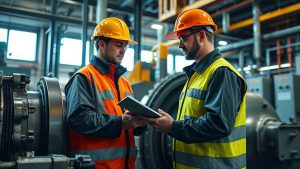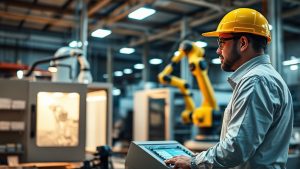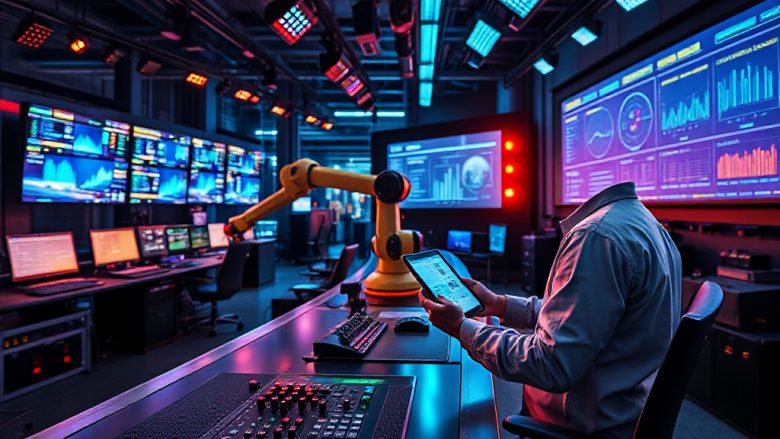
Walk onto a modern factory floor and the change is hard to miss. Ten years ago, a plant manager judged a line by how steadily it ran. Today the same manager watches sensor streams, checks a digital twin on a tablet, and waits for an alert that predicts a bearing failure three weeks out. The latest trends in industrial technology are not abstract ideas anymore. They are shipping in real plants, on real budgets, with real payback periods. Keeping up matters because the gap between early adopters and everyone else is widening fast. A plant that still runs on paper logs and reactive maintenance is competing against facilities that cut unplanned downtime by a third. That is not a small edge. It is the difference between winning contracts and losing them.
This roundup looks at the trends with genuine momentum, not the ones that only exist in conference keynotes. For each one, I will say what it actually does, where adoption stands, and what still holds it back.
The Industrial Internet of Things Moves From Pilots to Standard Practice
IIoT is the foundation most other trends sit on. Vibration sensors, flow meters, thermal cameras and power monitors now cost a fraction of what they did five years ago, and they talk over standard protocols rather than proprietary ones. The result is that condition monitoring has spread from a handful of critical assets to whole production lines.
The interesting shift is not the hardware. It is what happens to the data. Plants that once logged readings into a spreadsheet now push them into a time-series database and let rules or models flag anomalies. A pump that starts drawing slightly more current than its baseline gets inspected before it fails. That sounds simple, and it is, which is exactly why it works. Adoption is now mainstream in process industries and heavy manufacturing, and it is spreading into mid-sized operations as retrofits get cheaper.
The friction point is integration. Legacy equipment from the 1990s does not always speak modern protocols, and bridging that gap takes engineering time. Vendors have improved gateways, but the work is rarely plug-and-play.
AI Shifts From Hype to Practical Applications
Artificial intelligence in industry has gone through a predictable arc: enormous excitement, a wave of disappointing pilots, and now a quieter period where it actually earns its keep. The applications that survived are specific. Visual inspection is the clearest example. Cameras paired with trained models catch surface defects, missing components and misaligned parts faster and more consistently than human inspectors on a fast line. The models do not get tired at hour ten.
Predictive maintenance is the other strong use case. Instead of replacing parts on a fixed schedule, plants use sensor history to estimate remaining useful life. The savings come from two directions: fewer unnecessary replacements and fewer surprise failures. Both matter, and both are measurable.
What has not worked as well is the grand vision of a fully autonomous plant. Most successful deployments keep a human in the loop, with AI handling detection and humans handling judgment. That division of labour is unglamorous but effective. Expect adoption to keep climbing in inspection and maintenance, and to stay cautious in areas where a wrong decision is expensive or dangerous.
Digital Twins Become Operational Tools
A digital twin is a virtual replica of a physical asset, line or entire facility. For years it was a demonstration technology, impressive in a showroom and rarely used day to day. That is changing. The shift happened when twins stopped being static 3D models and started being connected to live data.
Now a twin can show you how a line is actually performing right now, not how it was designed to perform. Engineers use it to test a change before touching the real equipment. Want to know what happens if you speed up a conveyor by eight percent? Run it in the twin first. Want to train a new operator without risking a real machine? Use the twin as a simulator.
Adoption is strongest in aerospace, automotive and energy, where the cost of getting it wrong is high. Smaller manufacturers are more hesitant because building a useful twin takes data discipline that many do not yet have. The trend is real, but it rewards plants that already have clean sensor data and structured asset records.
Private 5G and Edge Computing Reshape the Network Layer
Two infrastructure trends are moving together, and they are worth treating as a pair. Private 5G networks give plants wireless connectivity with low latency and predictable performance, without depending on a public carrier. That matters for mobile robots, AGVs and any application where a dropped signal means a stopped line.
Edge computing is the other half. Instead of sending every sensor reading to a distant cloud, processing happens close to the machine. Latency drops, bandwidth costs fall, and sensitive production data stays on site. For a vision inspection system that needs to make a decision in milliseconds, edge is not optional. It is the only way the application works.
Adoption is uneven. Large facilities with clear use cases are deploying private 5G now. Smaller plants often find Wi-Fi and local edge servers sufficient, and that is a reasonable choice. The trend is not that every plant needs 5G. It is that the network is becoming a designed part of the production system rather than an afterthought.
Collaborative Robots and Additive Manufacturing Go Mainstream
Cobots have quietly become the most accessible form of automation. Unlike traditional industrial robots behind safety cages, collaborative robots are designed to work alongside people, with force limits and sensors that stop motion on contact. They are slower and less precise than their caged cousins, but they are far easier to deploy, reprogram and move between tasks.
The practical effect is that smaller manufacturers can now automate jobs that never justified a full robotic cell. Machine tending, palletising, quality checks and screwdriving are common starting points. A cobot that takes a day to set up and can be redeployed next month changes the economics of automation.
Additive manufacturing has followed a similar path into practicality. Metal and polymer 3D printing is now routine for jigs, fixtures, spare parts and low-volume components. The strongest use case is not mass production. It is solving the problem of a part that is obsolete, expensive or slow to source. Printing it in-house in a day beats waiting six weeks for a supplier. Adoption is broad in prototyping and tooling, and growing steadily in spare parts and short-run production.
What to Watch Next
If you are deciding where to start, the honest answer is to follow the data. Almost every trend on this list depends on reliable, well-structured information about what your machines are doing. Plants that get that foundation right find the rest much easier. Plants that skip it end up with expensive pilots that never scale.
The trends with the clearest near-term payoff are IIoT condition monitoring, AI-assisted inspection and cobot deployment. Digital twins and private 5G reward larger operations with specific needs. Additive manufacturing is quietly useful almost everywhere, especially for maintenance and tooling.
Looking ahead, the direction of travel is toward tighter integration. Sensors feed models, models inform twins, twins guide decisions, and robots act on those decisions. The plants that will lead in the coming years are not the ones that chase every new tool. They are the ones that build a coherent system where the pieces reinforce each other. That is less exciting than a flashy demo, but it is what actually moves the numbers. The pace of change is not slowing down, and the cost of standing still keeps rising.