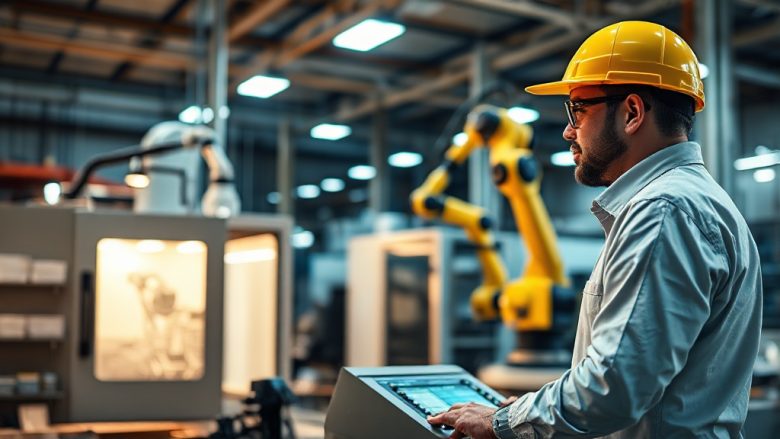
It’s 6am and the line is already behind. Two operators are hand-loading a press that should be running flat out, a night-shift quality issue has just been found on a batch of 400 parts, and the maintenance team is chasing a fault that only shows up when the machine gets warm. None of this is unusual, and none of it is anyone’s fault. It’s simply what happens when a process depends on people doing repetitive work at speed, hour after hour, with no data to tell you what’s really going on.
That scenario is why so many manufacturers are now looking hard at automation. The benefits of automation in manufacturing aren’t just about replacing people with robots. They’re about consistency, throughput, safety, and having the information to make better decisions. This article walks through what those benefits actually look like on a factory floor, where the numbers come from, and what you need to weigh up before committing capital.
What Automation in Manufacturing Actually Covers
Automation is a broad term, and it helps to be precise about it. At one end you have fixed automation: a dedicated machine that does one job, like a filling head or a spot welder, with no flexibility built in. At the other end you have flexible systems: robotic cells, CNC machines with automatic tool changers, automated guided vehicles moving material between stations, and software that schedules and monitors the whole thing.
In between sits a huge range of practical kit. Collaborative robots that work alongside operators without a cage. Vision systems that check a part in milliseconds. Sensors on existing machines that feed a dashboard. Even simple things like automatic screw feeders or pick-to-light systems count as automation, and they often deliver the fastest payback of all.
The important point is that automation isn’t a single purchase. It’s a spectrum, and most successful projects start small, prove the case, then scale. A manufacturer that tries to automate an entire line in one go usually spends more and learns less than one that automates a single bottleneck first.
The Core Benefits of Automation in Manufacturing
When operations leads build a business case, they tend to group the benefits into a handful of categories. Here’s what each one looks like in practice.
Higher and More Predictable Productivity
A machine doesn’t take a tea break, doesn’t slow down on a Friday afternoon, and doesn’t need retraining when a product changes. That sounds obvious, but the productivity gain is often bigger than people expect because it compounds. A robot that loads a machine in four seconds instead of eight doesn’t just save four seconds. It keeps the spindle cutting, reduces the queue in front of the machine, and lets the next process run at its natural rate.
In practice, manufacturers who automate a genuine bottleneck often see output rise by a third or more on that station, and the gain holds because it isn’t dependent on operator fatigue or shift patterns. The bigger win is predictability. When cycle times are consistent, you can promise delivery dates with confidence, which matters enormously if you supply customers who run just-in-time.
Consistent Quality and Less Scrap
Human beings are remarkable, but they’re not repeatable to a tenth of a millimetre over an eight-hour shift. Automation is. A robotic arm places a component in the same position every single time, and a vision system checks it every single time. That consistency shows up directly in scrap rates and rework.
It also shows up in traceability. Automated cells can log the parameters of every part they produce, so when a customer reports a problem you can trace it back to a specific batch, a specific tool, and a specific set of conditions. That’s difficult to do when the record is a paper traveller with a few ticks on it. For manufacturers in regulated sectors, that traceability alone can justify the investment.
Improved Safety and Fewer Injuries
Some of the strongest arguments for automation are about people, not machines. The tasks that are hardest to staff are often the ones that are hottest, dirtiest, heaviest, or most repetitive. Manual palletising, loading raw stock into a press, welding in awkward positions, applying adhesives in a fume-heavy area. These are the jobs where injuries cluster and where recruitment is hardest.
Automating them removes the exposure entirely rather than managing it with PPE and rotation. That reduces lost-time incidents, lowers insurance premiums over time, and makes the remaining jobs more attractive. A plant where the operator supervises a cell instead of lifting 20kg parts all day is a plant that can hire and keep good people.
Lower Operating Costs Over Time
Automation has an upfront cost, and it’s rarely small. But the operating picture changes in ways that are easy to underestimate. Labour cost per unit falls, especially on multi-shift operations where one automated cell can cover what previously needed three shifts of staff. Energy use per part often falls because machines aren’t left idling between manual operations. Material waste drops because the process is consistent.
Maintenance becomes more planned and less reactive, because sensors flag a bearing that’s running warm before it fails and stops the line. That shift from reactive to predictive maintenance is one of the quieter benefits, but it’s often the one that keeps a plant manager sane.
Scalability Without Proportional Hiring
When demand rises, a manual operation has to hire, train, and find space for more people. An automated operation often just runs longer or adds a second shift with the same headcount. That’s a meaningful advantage in sectors where demand is lumpy, and it’s a big part of why automation appeals to manufacturers who’ve been burned by a sudden order spike followed by a quiet quarter.
It also makes it easier to add capacity in stages. You can install a cell sized for current demand, then add a second cell when volumes justify it, rather than building a whole new line. The capital goes in when the revenue does.
Better Data and Decision-Making
An automated machine can tell you what it’s doing, how long it took, and whether it stayed within tolerance. Multiply that across a plant and you get something genuinely useful: a live picture of where time is actually going. Most manufacturers are surprised by what they find. The bottleneck they assumed was the problem often turns out to be a minor station, while a supposedly reliable machine is quietly eating 15% of capacity through micro-stops.
That data feeds directly into improvement work. You can see changeover times, identify the tool that fails most often, and measure whether a process change actually helped. Without automation, most of that information simply isn’t captured.
What to Weigh Up Before You Automate
Automation isn’t free of complications, and a credible business case has to acknowledge them. The capital cost is the obvious one, and payback periods vary widely depending on the application. A collaborative robot cell doing a simple pick-and-place might pay back in under two years, while a fully automated line could take considerably longer and carries more technical risk.
Flexibility is the second consideration. Fixed automation is efficient but unforgiving. If your product range changes frequently, you need to design for changeovers from the start, or you’ll end up with a machine that’s brilliant at making something you no longer sell. That’s a common and expensive mistake.
Skills are the third. Automation shifts the workforce requirement from manual dexterity to technical competence. You’ll need people who can program, maintain, and troubleshoot the equipment, and those people are in short supply. Planning for training, or for a maintenance partnership, is part of the project, not an afterthought.
Finally, there’s the human side. Operators who feel their job is being automated away will resist, and that resistance can quietly undermine a project. The plants that handle this best involve the people who currently do the job in designing the automated version. They know the failure modes, the awkward parts, and the workarounds that keep the line running. That knowledge is worth more than any vendor’s specification sheet.
The benefits of automation in manufacturing are real, but they’re not automatic. They come from choosing the right process to automate, designing for the product range you actually have, and treating the people on the floor as part of the solution rather than an obstacle. Start with the bottleneck that causes the most pain, measure before and after, and let the results make the case for the next step. Done that way, automation stops being a gamble on technology and becomes a straightforward operational improvement.